About Me

My photo
I am just a mom: a mom of three kids and one of them is hearing impaired. We are a busy family and I am a very busy mom. I want my hearing impaired daughter, Brooke, to have every advantage so I try to incorporate as many lessons and strategies into our every day life. Most of the teaching I do with Brooke is incorporated into our daily routines and parent-directed play. This blog will include some of our formal lessons but mostly it will be learning to listen in the everyday.

Thursday, April 28, 2011

Table Learning


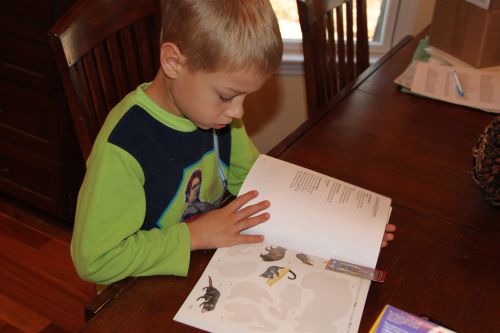
These are some of the other things we do during the day. I call this time of our day Table Learning since the kids are at the table with me to help and instruct them.


Learning Poster I use this teaching poster every morning. On it I have an envelope to stick our home0made letter books, a letter poem, the Awanna memory verse for the week, our nursery rhyme, and a spot for letter flashcards, number flashcards, shape flashcards, and color flashcards.


Letters


We complete a Capital Letter craft for each letter. I print out a block letter and fill it with items that begin with the sound. For letter Nn, we filled it with numbers. Letter Ll we filled with ladybug stickers.


Sounds and Auditory Activities


Here we are sorting itsy-bitsy miniatures by beginning consonant sounds


Writing


Letter hunt from confessions of a preschooler


a coloring sheet from first schools


Patterns


Sometimes we do patterns at the table before give it to the kids as a magnet tray.


Thinking Skills


In this activity, we are looking for one that is different.


Computer Skills


Big Brother

Fill-In the Rhyming Words

Can your child fill-in rhyming words:

‘There was an old woman who lived in a shoe; She had so many children she didn’t know what to d__’?

"Baa Baa Black Sheep have you any wool? Yes, sir Yes sir Three bags f___."

"Hickory Dickory Dock, the mouse ran up the cl____."

Little Bo Peep lost her sh___."

Provide your child with the beginning sound so that she will begin to recognize the initial sounds in rhyming words.

Tuesday, April 26, 2011

Listening Awareness

Listening Awareness Have child close eyes and listen for three sounds you make. Ex: Parent claps hands, snaps fingers, and stomps feet. Child opens eyes. Parent says, "First you heard ______. In the middle you heard_____. And last you heard ______." Child fills in blank. Continue listening game using the following: animal sounds (moo, oink, quack) color words familiar items (tree, grass, truck) letters of alphabet sounds of alphabet "b-a-t"

Sunday, April 24, 2011

Kids Clix - Speech Sound Discrimination

Kids Clix is a listening program for listening to the sounds in speech. You can download the program for free from The Hearing Journey.


Once downloaded, your child will begin with a placement test. There are 50 items on the placement test that assess 10 levels. They suggest you begin at the lowest level where you scored 3 out of 5 or less. For Brooke this category is "initial manner" meaning words that have different beginning sounds but the same middle and ending sounds like:
pea, tea, key (voiceless sounds) or bay, day, gay (voiced sounds)

Since this is a computer voice instead of face-to-face human voice, it is more difficult for children with hearing loss.

We will being the program at Level 5: First consonants different by manner of production.


Friday, April 22, 2011

What does the word 'sam" start with?

Play games with the beginning sounds in words. Give the child a word and see if she can tell you the sound that the word starts with. For example,"What does the word “sam” start with?" and your child would respond with /sssss/. Help the child by saying the word slowly. Help him learn to hear these sounds. Since this is the first time we are trying this activity, we started with the sounds that can be stretched out (such as m, s, f, l, n, r) and we avoided the blended consonants (br, sm, fl, sh) that are much more difficult to segment (for example give the word ‘big’ not ‘broom’). Be careful not to ask the child for the name of the letter, but the sound of the letter. For some words, Brooke would say M instead of the sound /mmmmm/. Of course, that is a correct answer but I would refocus her on the sound by saying, "Yes, M makes the /mmmmmm/ sound in the word mitten." Try these words: Scooby Doo sit snack sailboat sun Superman sunflower six moth mouse motorcycle monkey mitten moon mop fox four fan fire fork feet fish five leaf ladybug lollipop lemon lamb lips lion nail net nose nest numbers nut needle rabbit rose ring rain rainbow rat rake rhino raccoon Then try these sounds that are the earliest to develop and you child most likely has mastered: p, h, w, b, t, d (the /h/ is a difficult sound to hear so keep that in mind) Then these sounds which are harder speech sounds: k, g, v, y

Wednesday, April 20, 2011

Shaking Eggss

objective: a. listen to a variety of sounds b. compare the sounds and find the 2 that match Points to remember: 1. Listening and recognizing sounds is an important step in learning to recognize sounds in words.

Lesson:

1. Fill 12 eggs with 6 different objects so that there are 2 of each object. I used marshmallows, pennies, rocks, pom poms, bells, and macaroni.


2. Place the eggs in the carton. In the picture I have the eggs organized by color, but the sounds are not in the same color eggs. For example, the macaroni is in a purple egg and an orange egg.

3. Give your child 6 eggs, each a different sound. Listen to each one at a time. Set those eggs on the table and leave the 6 matching eggs in the carton.


4. Give your child 1 egg from the carton and have her listen to it. Then ask her to match it to one egg on the table that sounds the same.


5. Once she has found the match, open the eggs and look to see if they are the same.


6. Celebrate!


Here is a video of Kate and Brooke playing with the eggs. This is after we did it a few times and they knew the objects inside.


Modifications:

1. Switch out the objects and play again.

2. Set out all 12 eggs at one time and have your child find the matches - this is much harder since there are 11 options to choose from.

Monday, April 18, 2011

Foochie and the Easter Bunny

objective:

a. to follow directions with 3 or more critical elements

b. to demonstrate understanding of location vocabulary such as next to, on top, in front of, etc.


Points to Remember:

1. You will need 5 jelly beans: red, yello, purple, green and black

2. You will need to download this from The Listening Room before they change activities.


Lesson: 1. Have your child start as the Listener. I choose a card and without letting Brooke see, I describe where to place the jellybeans with sentences such as, "The purple jelly bean is in front of the Easter Bunny. The black jellybean is on top of the doghouse." 2. When all the candies are in the proper place, check the card to make sure it is correct. 3. Have your child take a turn describing where to place the jellybeans while you place them on the scene


Modifications:

1. Set a timer and try to get all the jellybeans placed before the timer rings.

2. Download the game here: Foochie and the Easter Bunny